Mythical Creatures Today - Video Games (Dragons)
Inspired by the new Mythical Creatures exhibition at Colchester Castle, which I have been working on for months, I thought I would write a series about the representation of Mythical Creatures in the modern day.
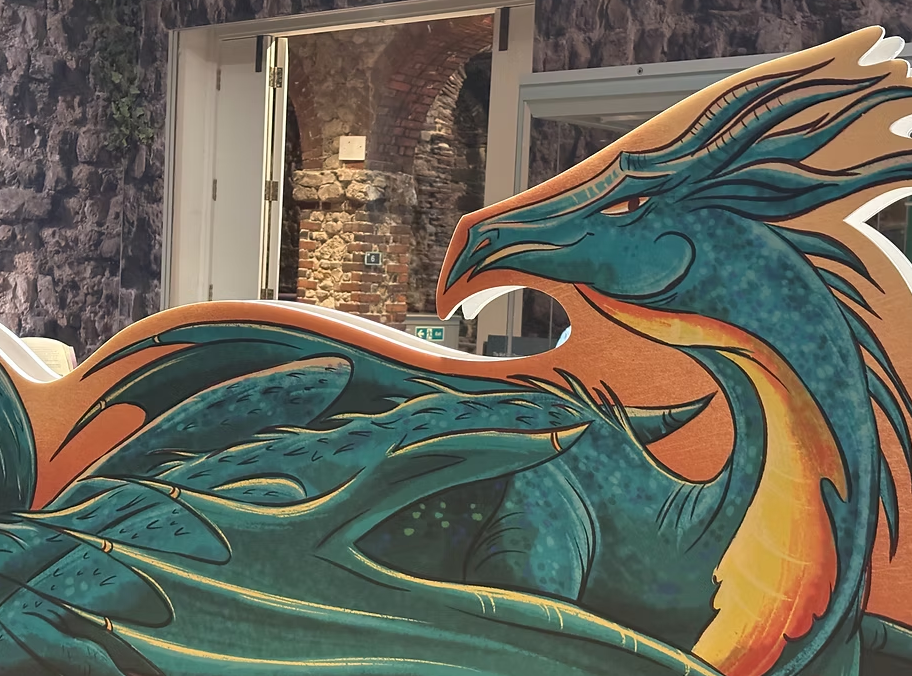
Dragon illustration in Colchester Castle’s Mythical creatures exhibition. Artwork by Kyria McKie.
In the exhibition, we touch upon the idea that people continue to not only share stories of mythical creatures, but also believe in them. Whether we are talking about cryptids, such as Bigfoot, or folkloric beings, like fairies, I have encountered many people in my life who believe such creatures exist. Some of these may be cases of misidentification, such as the medieval dragon sightings that some now believe to have been escaped crocodiles or pythons. Yet, the notion of mysterious and monstrous beasts roaming unexplored areas of our world is something that will always excite and provoke questioning.
To start, I wanted to explore one of my favourite genres and something I have always enjoyed since childhood - video games. Video games not only provide opportunities for incredible storytelling and visual creation, but it allows the player to experience the story and the world that has been created. I will focus on the four creatures of the Mythical Creatures edition; dragon, mermaid, unicorn and griffin. Showing the ways in which these beasts have been represented in video games (old and new), whilst seeing which are the most “accurate” to the historical tales that inspired them. As the content is so vast, I’m going to split this into several posts, starting with my favourite…dragons.
Here be dragons
Dragons are everywhere in video games. Like, literally everywhere. Even games that aren’t explicitly fantasy can throw in a dragon knowing popular appeal could make for increased sales. They have even entered the world of Sci-Fi, which some see as entirely distinct from fantasy (I do not). So here are a few video games featuring dragons that represent them in quite different ways.
Pokémon - Not just Charizard
Charizard should be Pokémon’s official mascot. There I said it! Although everyone loves the yellow electric mouse, Charizard continues to be one of the most popular monsters in the franchise. Featured in every single main line game, most of the spin-offs and even getting several alternate forms, it’s clearly one of the creatures most cherished by the company. Yet dragons feature far more widely in the series than just our ferocious orange, fire-breathing friend.
As well as the many other Pokémon that look like dragons, from all over the world, there is an entire type (one of the categories of Pokémon) called the Dragon type. This means that, even some Pokémon that don’t look like traditional dragons can technically be dragons, such as the controversial Alolan Exeggutor.
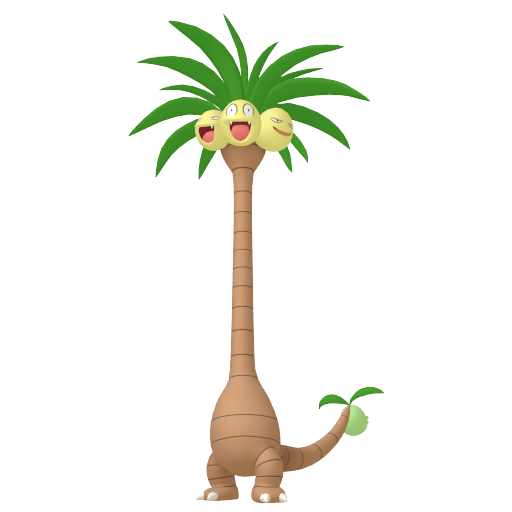
The dragon, Alolan Exeggutor. Image by Dakshkohli23, Deviant Art.
Many ‘legendary’ Pokémon, the almost unique creatures that are often only catchable once per game, are in the form of dragons and are dragon types. The legendary Pokémon that represent the Generation IV games of Black and White are dragons, with a third dragon legendary Pokémon connected to their story. Previously in generation III, a more Eastern style dragon, Rayquaza, was introduced as a being that calms the two warring legendary Pokémon Groudon, representing the earth, and altogether, representing the sky. In East Asian legends, serpent dragons like Rayquaza were often seen as symbols of balance, especially within nature. It’s probably the first dragon in the series to reflect the beliefs and tales of Pokémon’s country of origin, Japan.
Beyond the legendaries are a whole host of dragon shaped and dragon adjacent creatures. They each reflect different styles of dragon from throughout the myths of the world.
Skyrim - Fus Ro Da(ragons!)
Arguably one of the greatest role playing games ever created is Skyrim. The fifth instalment in the Elder Scrolls series, it provides a vast explorable world full of beautiful scenery, challenging quests, an array of weapons and armour…oh and you can talk to dragons.

The Skyrim logo. Game and logo created by Bethesda Game Studios.
The main focus of the game is for you to eradicate the dragons, which I’m not a fan of, but in so doing you end up gaining some incredible magical abilities. In order to use these abilities, you must shout a combination of three words. These words can be found written on walls across the world, or some are taught to you by the mysterious ‘greybeards’.
Without wanting to spoil the game, a key part involves the dragon Alduin returning after many years to resurrect his fellow dragons. It is in the early game, having escaped potential execution and bringing news of Alduins return to a local king that you end up fighting one of these lesser dragons. After defeating it, the power of the dragon flows into you, making those nearby realise you are ‘dragonborn’. From then on your quest to learn more about these mysterious ‘Dragonborn’ and bring an end to Alduin begins.
It’s been 14 years since Skyrim first came out and, despite several remasters and the arrival of Elder Scrolls online, we are yet to see the highly anticipated 6th game in the Elder Scrolls series. The continued popularity of this game after so long, with over 30,000 players still playing the game across its various versions in 2025.
Dragon Age - Where be dragons?
In the newest version of this series, Dragon Age: Veilguard, there are only eight dragons that you can fight across the entire game. Some of them you don’t even have to encounter if you don’t want to, or if you miss a side quest. At times, it feels less of a “Dragon Age” and more of a “Demon Age”, with much of the narrative inspired by biblical concepts of good and evil. They even have a “Pride” demon. 😬
Although the recent Dragon Age took a step away from the fully open world concept that most RPGs seem to be going for these days, with lots of mini-open worlds to explore, it is certainly one of my favourite games of recent years. Described by some* as “woke” the character customisation is some of the best I’ve seen and the storylines cover some pretty gripping and serious subjects. Although some go to video games to escape reality, the realism of the characters and plots within this game really resonated with me.
Anyway, back to the dragons. The main dragons you fight are connected to the elves gods of the land of Thedas, where the game takes place. These gods are accompanied by dragons in several instances when you try to fight them, having to fight their dragon pets instead. Other dragons are parts of side quests, including when you accidentally piss off another elven god when trying to ask for their help. Essentially, the dragons in this game are seen as semi-divine beasts that defend the elven gods. However, in earlier versions of Dragon Age this wasn’t so much the case. I’ll never forget when first playing Dragon Age: Inquisition, having decided to just wander and explore the first main area of the game I suddenly found myself face to face with one of these giant winged beasts that’s immediately knocked me out in one attack.
*idiots*
Dragon’s Dogma - Dragons on the brain
This is an incredibly new game series for me, admittedly with only two versions. I have recently been playing Dragon’s Dogma 2, and have found another banger of an RPG.
The premise of this game is that you as the main character are an ‘arisen’ , someone almost killed by a dragon but the dragon chose to spare you while taking a piece of your heart. Although this makes you extra special and gives you powers (sort of), it does mean that any of the other dragons that live within the land of Vermund will telepathically start speaking with you if you get too close, drawing you and your team into battle. It wasn’t until my character was level 35 that I felt anywhere near ready to take one of these powerful beasts on, yet you can run into them very early in the game if you’re not careful.
Like many of the games we’ve seen, there appears to be a trend for having main characters, spared from death, who acquire new powers linked to dragons and yet are then expected to go and kill the all…
Sword and Fairy - 9 heads are better than one
A much lesser known game series, but easily one of my favourites in recent years. The visuals, the gameplay and the storyline are all beautifully produced. Despite some glitches with the navigation mechanics on the map.
In the most recent Sword and Fairy game, “Together Forever”, you play as one of four characters, though the main (and best) is clearly 月清疏 (Yue Qingshu). She is the disciple of 明庶门 (Mingshu School) where she, amongst other things, learns about the taming and control of fairies/spirits. These fairies turn out to be huge, super-powered beasts in disguise, with incredible magical powers that you can use in battle.
Of these fairies my favourite easily is 哈占(Hazhan) who is of course… a cat. Though not just any cat, this round furball turns into a fierce snow tiger when in battle. Most of the fairy creatures turn into larger versions of themselves with magical powers, but you do encounter some other powerful beasts on your journey.
Though there are very few dragons in the series, in a couple of versions you encounter 九嬰 (JiuYing). The name literally translates to “9 baby”, referencing its number of heads and the baby-like cry it makes. The heads each spout Fire and Water similar to other dragons found across the world. This creature, like many others in the game, comes from Chinese mythology and folklore.