50 LGBTQ+ Finds - what wasn’t included
My second book will be hitting the shelves (physically and digitally) on 15 April 2025. This addition to the “50 Finds…” series takes a new spin on the model, presenting the history of sexuality and gender through the lens of archaeology found by members of the public and recorded with the Portable Antiquities Scheme (PAS).
Whilst bored in the lockdown of 2020, I started my research into the PAS database to see what objects I could find that reflected LGBTQ+ history and culture. To my surprise, there were a lot, and so I set myself the challenge of finding 50 distinct stories that could be shared in a book. Although I struggled to make 50 relevant topics with the material at hand, some left me spoilt for choice with the objects I could chose to tell them.
In celebration of my book's upcoming launch, here are some of the key themes I explore in the book and some of the objects that didn’t make the cut...
Historical Figures
There are enough LGBTQ+ historical figures to write several books, and many of those included in mine could have entire books to themselves. However, due to factors such as the word limit and being restricted to 50 objects, I had to be incredibly concise with my writing.
Although I managed to include some of the more significant and well-known individuals within this chapter, I sadly couldn’t include everyone I wanted. In an early draft I included Alan Turing (1912-1954), the incredible scientist and mathematician who worked at Bletchley Park, helping decode the correspondences made by the Nazis in order to direct British military action. The object I chose was a seal matrix with an apple decoration on it. The apple has become synonymous with Alan Turing and his legacy, as some believe it was an apple laced with cyanide that led to his death.
Alan had an incredible life up until the point where people started to suspect his sexuality. He is known to have had relationships with men, and at that time, it was not only socially frowned upon but illegal. He was forced to take feminising hormones to alter his body, something which he had no desire to do. Historians are torn as to whether Alan chose to take his own life or whether someone sent a poisoned apple that eventually killed him. In either case, his life was drastically cut short due to society's perception of homosexuality.
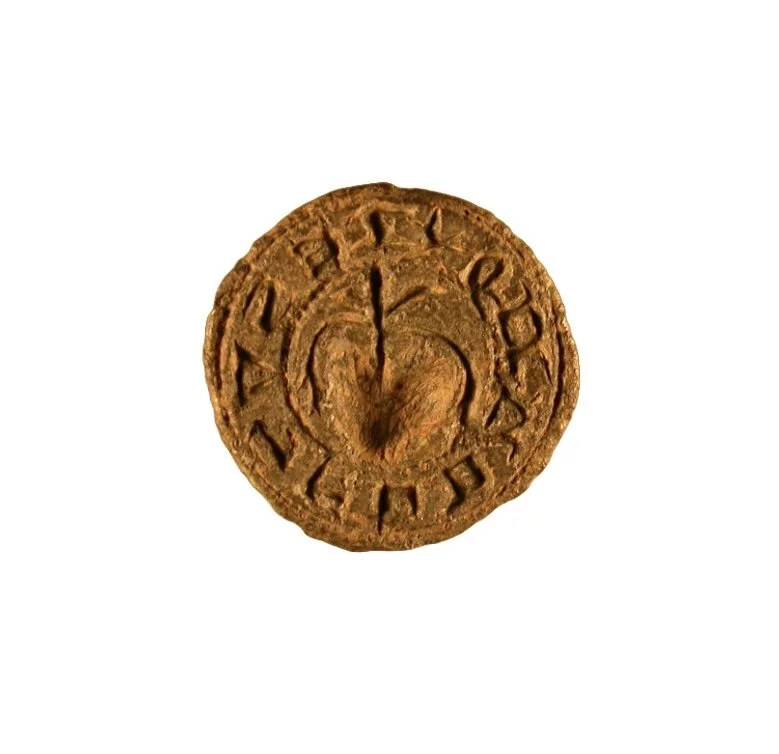
A seal matrix showing an apple (ESS-6B17D3)
The Natural World
One of the common arguments thrown against any LGBTQ+ person is that it’s “not natural”, even though the animal kingdom (of which we are a part) contains same sex activity and nonbinary sex within its billions of species
There were many animals and plants I couldn’t include in my book due to space limitations. The clown fish which changes sex from male to female when they become the most dominant. Violets being associated with Sappho, amongst other lesbian icons. The world was my oyster (which can also change sex, and back again)!
One particular story, which explains a lot about why sexuality and sex changing in the natural world has been little known until recently, comes in the form of penguins. In 1912, during Captain Scott’s mission to the Antarctic, it was documented that male Adélie penguins were observed taking part in homosexual activity. However, the section of the paper that mentioned this was mysteriously “lost” until decades later when it was rediscovered. Gay penguins are perhaps one of the more widely recognised stories from the many examples that have been reported in zoos across the world. The story of Scott’s expedition explains why these stories did not make it into public consciousness before then. Homophobia has been rife within academia for centuries, and any LGBTQ+ stories were often censored or hidden entirely.
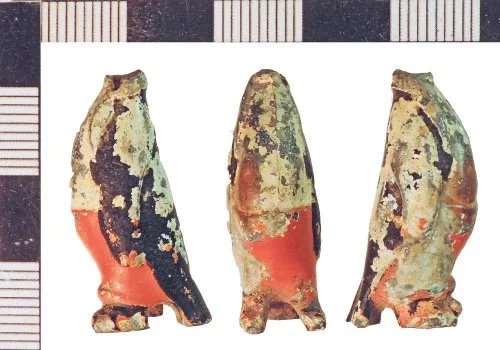
A toy penguin from the 1900s (NLM-9BCFE6)
Symbols and Language
Due to my limitations, I had to restrict the book to predominantly English language and symbolism. There is scope for an entire book on the history of LGBTQ+ language and symbols across the world (an entire series even). Yet, I was still able to get quite a significant amount into this chapter, just focusing on the English-speaking world.
Language is both incredibly powerful and meaningless at the same time. Entirely socially constructed, words can at once fully explain and be completely misunderstood. The language used around LGBTQ+ people has evolved and changed over time. Some will see this as our community “moving the goalposts” and trying to “trick or confuse” people, when what we’re doing is trying to find the words that more accurately represent who we truly are.
That is why symbols have been used universally and for much longer periods than words have. The rainbow is one such symbol that has become synonymous with the LGBTQ+ community globally. Although it has been incorporated into other symbols, such as the pride flag, its use as a curved series of coloured lines can be seen in LGBTQ+ safe spaces throughout the world. Despite some other groups trying to co-opt the symbol, and I can’t say that any one group truly owns a symbol, it has persisted for a long time as an indicator of like-minded individuals within a safe space.
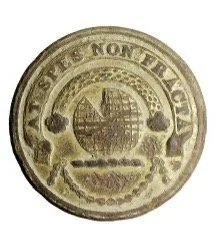
A button from the 1800s showing a rainbow between two clouds (SUR-403009)
Mythology and Folklore
There are countless myths and legends throughout the world that include gender changing individuals and same sex relationships. Some are based on deception, such as the stories of Thor and Loki. These we perhaps cannot take as a true representation of acceptance within those cultures, though elements of those stories might be looked at in this way. For example, while some uses of feminine language to describe gods have been explained as mortals making fun of them, Odin’s use of feminine magic could suggest there was a more fluid understanding of gender in the Viking world (who would make fun of the king of the gods?!)
Other stories quite clearly show that same sex relationships were recognised and accepted within those cultures, and gender might not have been as binary as we have often described it as. Another aspect often connected to religion and practiced by many worshipers, even within the abrahamic religions, is chastity. There are however stories linked to chaste religions where the goddess is known to have had no interest in sex or relationships. One such example is that of Diana, to the Romans, and Artemis, to the Greeks.
Diana was known to regularly reject the advances of the gods and chose a life without sex. Some have suggested that the mythology of Diana tells us she had relationships with women, but this could indicate an asexual identity with romantic desire. This shows an awareness that some people might have no sexual or romantic desire, as the gods were often reflective of the mortal world. Despite their immortality, the gods were subject to the same behaviours and activities as humans. Therefore, Diana has been argued as a reference for asexuality within the ancient Roman world and quite possibly a positive role model for those who similarly lacked those desires.
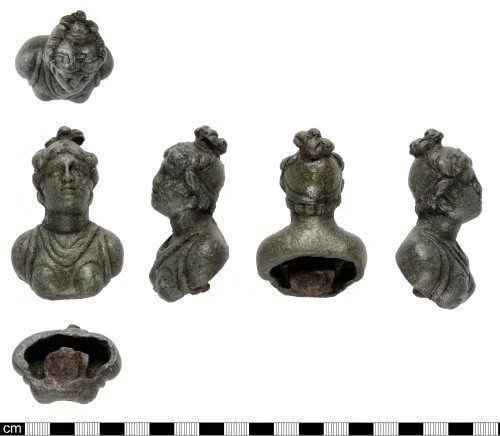
A copper alloy mount depicting the goddess Diana (SOM-762B9F)
Communities
LGBTQ+ people have always created groups of like-minded people to feel safe. Sometimes, those groups already existed and attracted LGBTQ+ to them, knowing that they would fit in and their sexuality or gender would not be questioned. Pirates, for example, who already lived on the fringes of society, were known to attract people who had same sex attraction, whilst women who wanted to be pirates sometimes had to live as men.
Although I mention Ancient Greece in the book through the symposium, there is one group of Greeks I wanted to mention but couldn’t find an object with a strong enough connection to include it - the Sacred Band of Thebes. They were a group of male soldiers who were able to defeat the infamously powerful Spartan army. The Spartans had their own same sex tendencies, but the Sacred Band of Thebes went above and beyond. The group of 150 individuals were made of male-male partners. The idea was that their love for one another would make them fight harder to protect their partner in battle. Although this is an incredibly romantic sentiment, much like all ancient history, the nature of these relationships has likely been distorted by a modern lens.
Same sex love in Ancient Greece wasn’t particularly uncommon, and so a group like this wouldn’t have been as ground breaking as we might imagine it to be today. Equally, the issues around translation have meant many relationships in the past have been misinterpreted (in all directions; gay to straight, straight to gay, etc). Nonetheless, this story highlights the normalisation of same sex attraction in the past and the often sensationalisation of it that happens in the modern day.
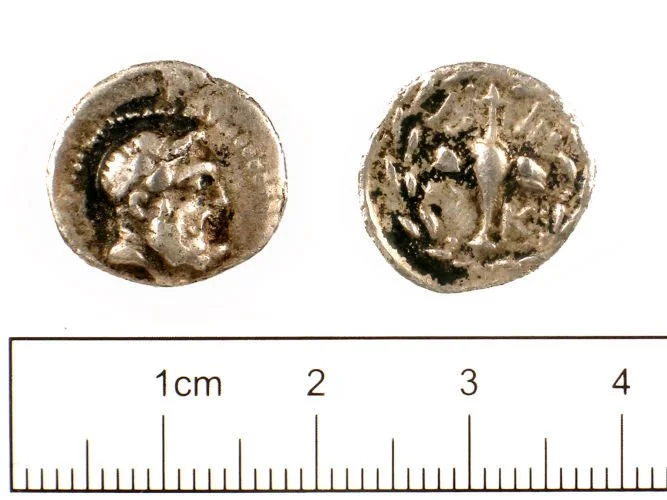
A forged Spartan coin made in the modern day (SUSS-D39F62).