The People of Roman Colchester: In their own words
I have been doing some personal research lately, the first since I finished writing 50 LGBTQ+ Finds. I have always had an interest in written records in the past and how they are used alongside objects found archaeologically. What I find even more exciting is when objects themselves have writing on them that can be used to help us better understand life in the Ancient World. These objects give us a real insight into personal stories and connect us directly to an individual in the past, in a way that historical accounts and other written documents don’t. I hope, in the future, to produce a fully comprehensive work on the writing of Roman Britain, made by the people living here. So for now, here are some of the inscriptions from Roman Colchester, known then as Colonia Claudia Victricensis.
Enervinus - The drunk?
Roman ceramic fragments are some of the most common objects to find on archaeological excavations. In fact, in Rome there is an entire mountain made out of discarded pottery fragments known as Monte Testaccio. On occasion, people in the past would inscribe words onto the vessels, probably before they were broken. In most instance we find names, probably the owner of the vessel, or sometimes numbers that may have indicated quantities of whatever was in side. However, some inscriptions are far more puzzling.
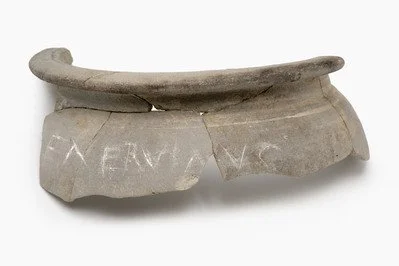
COLEM:2010.T64
A section of Roman greyware with a word engraved onto the outside. Possibly ‘ENERVINVS’.
These fragments of Roman greyware have been assembled together revealing a more complete inscription on the outside of the vessels. Although there may be more letters missing, a word does seem to appear, though not one that is particularly familiar to readers of Latin.
‘ENERVINVS’, or ‘Enervinus’ is what the writing appears to spell out. Although this is not an accurate Latin word, it is incredibly close to the word Enervare, meaning to weaken or make powerless. Literacy in the Ancient World was nowhere near what it is today, though if you scour social media you will find all sorts of misspellings of fairly common words, let along the less common ones. Therefore, it’s quite possible someone wrote this on the vessel, to suggest how you might become if you were to use the contents.
As to what the contents were, we will never know. Perhaps it was some form of alcohol, or even a form of poison (though it would be fairly foolish to give yourself away by writing that label on the vessel). In either case, we know that the owner, a resident of Roman Colchester, chose to mark this vessel with that particular word, giving us a glimpse into their life.
The best wine in the world
One thing we know about Britain under Roman rule was that the Romans brought large quantities of wine with them. We also know, from other forms of written evidence in places like Pompeii, that there were various degrees of quality of wine that could be imported. The greatest and most sought after being Falernian wine.
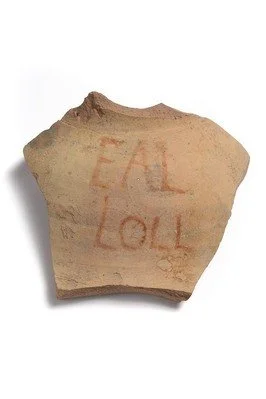
COLEM:1939.301
A fragment of pinkish ceramic from an amphora. The words FALL LOLL have been inscribed on the outside in red paint.
Falernian wine is a particular variant of white wine grown on the slopes of Mount Falernus. Like modern champagne, you couldn’t pass off wine grown anywhere else as Falernian, it was specific to that region. Not only was it incredibly sought after, due to its uniqueness it was incredibly expensive. A graffito in Pompeii tells us Falernian wine would cost four times as much as normal wine.
What is interesting about this particular fragment is that it not only tells us that Roman residents of Colchester were able to drink Falernian wine in the far limits of the Empire, but we also get the name of the producer of this particular vintage. A man named Lollius, indicated by the LOLL on the inscription, was the person responsible for the batch that made its way to Colchester. Sadly we know nothing about him as there are no records of the growers, “bottlers” and traders of Falernian wine. Yet, this inscribed fragment fragment tells us much about people in a provincial Roman town.
Toilet humour
What the graffiti in places like Pompeii has told us is that people haven’t really changed much in 2000 years. The same is true for Colchester, though there is far less in the form of personal writing that has survived. One thing that archaeologists always look out for are ways in which you can tell the function of a room or a building, based on the things excavated inside it. With this inscription, it is quite obvious where the writer was seated.
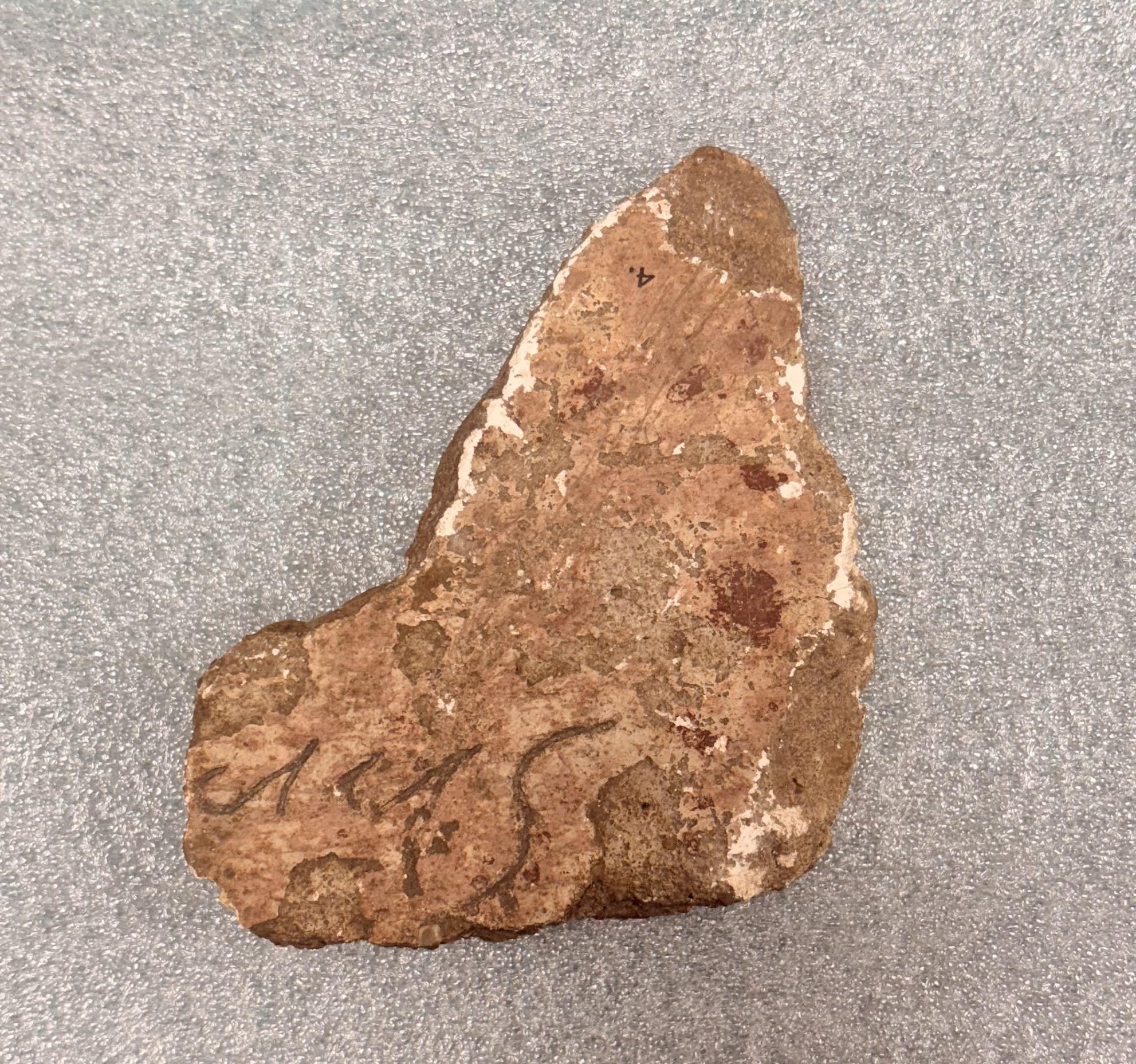
COLEM:2001.99.9
Whatever it is, the way you tell your story online can make all the difference.
Someone living in Roman Colchester, at some point, engraved the word ‘cacas’ into the wall. The word means ‘you are shitting’ and was clearly intended for the next occupant of this Roman toilet. In many towns across the Roman Empire, communal toilets were fairly common. Open seats with a sponge on a stick, dipped in a pot of vinegar, in the centre for you to clean yourself afterwards. There was no privacy unlike in many (but not all) public toilets in the modern day.
A practicing craftsperson or magic spell?
Inscriptions can be found in all sorts of strange places. Most are written where they are intended to be seen, while others can be hidden in places you wouldn’t expect.
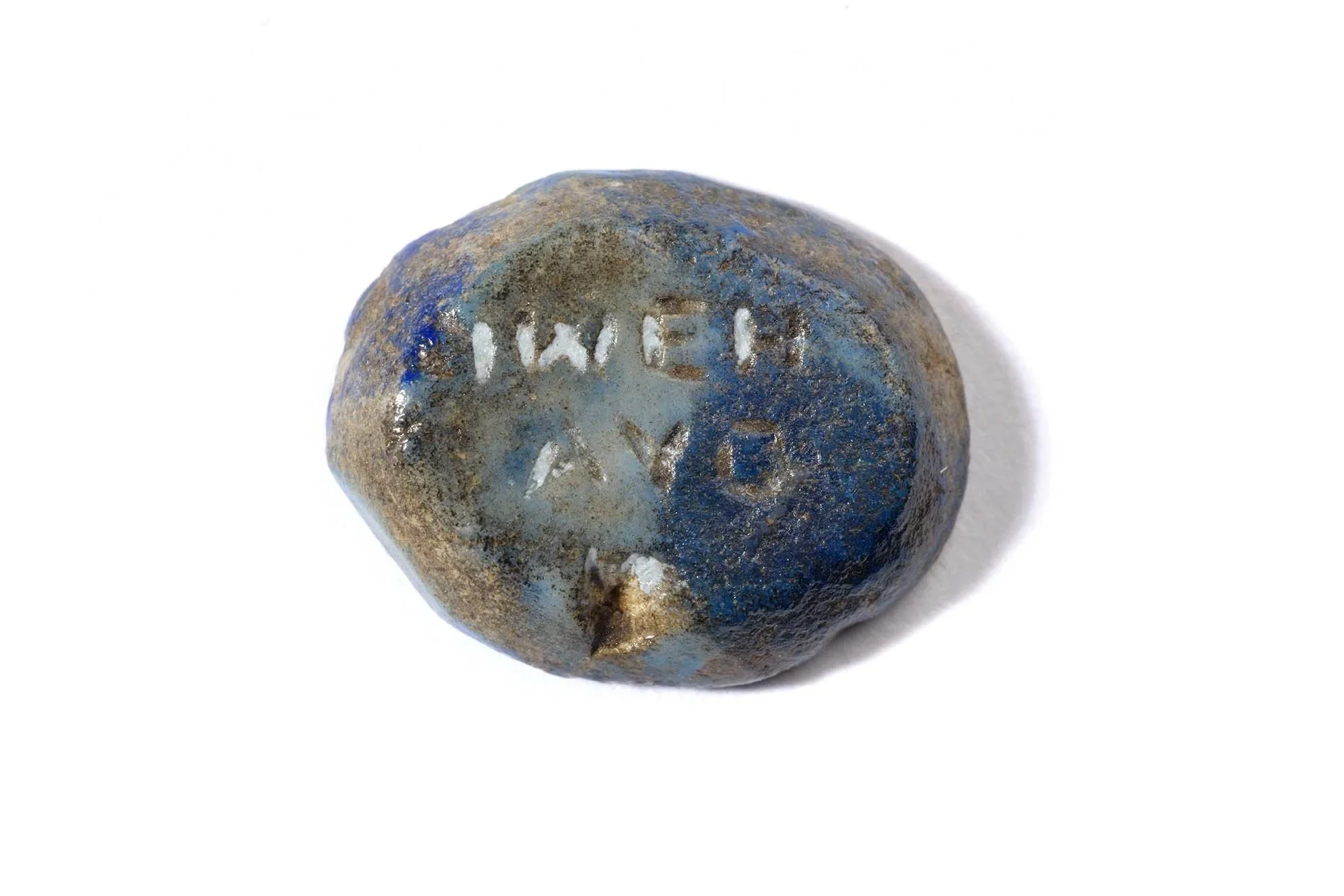
COLEM:1924.4941
The back of an intaglio with Greek vowels engraved onto it.
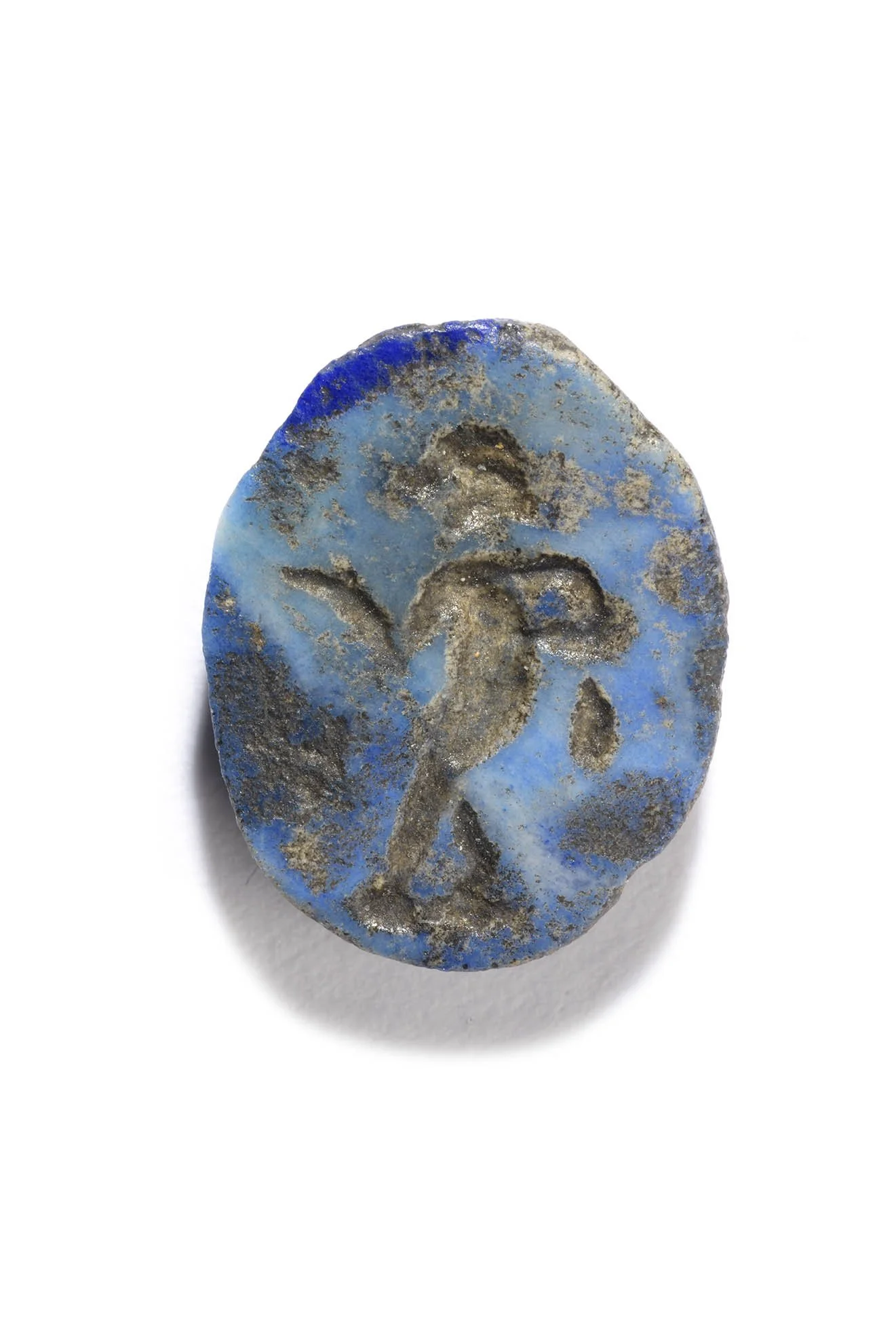
COLEM:1924.4941
An intaglio depicting the god Harpocrates.
On the back of this intaglio are the Greek letters “ΙωΕΗ /ΙωΣΗ” and “Ανο / Αγο”. For a long while, these have been interpreted as “Greek vowels” inscribed on the back of the stone to act as magical protection for the wearer. Spells in the Ancient World would often have to be hidden to be effective, either ritually destroyed or deposited somewhere secretive. The fact that Harpocrates, God of secrets, is depicted on the stone adds to this theory.
There is also the issue of reading the letters, which as mentioned have been interpreted as simple Greek letters. Depending on how it’s read however, this may in fact be something more. “ίωση ᾰ̓́γω” an alternative spelling of the letters, would translate to “I bring disease”, perhaps in fact a curse on the intaglio which would have been fitted into a ring and not readable for the wearer. An alternative, though less likely, is “ίωση ᾰ̓́νω” which would sort of translate to “disease/sickness above” perhaps referring to Harpocrates. Would this suggest the worship of Harpocrates brings disease?
Sadly, being unable to go back in time and ask the engraver what they meant, we can never know for certain what the words signify. However, I also like to think that there is a possibility this is just evidence of an intaglio maker practicing their carving on the back of the stone, either to act as a showpiece to potential customers or so it could be easily hidden if this intaglio was chosen to be mounted into a ring.
Thank the Gods
In Roman belief, when you wanted something you would ask the gods for help. There was a god for absolutely anything you might need. You could ask one of the big-name gods, like Jupiter, Mars, Juno or Minverva. Or you could find a more bespoke god, like Cloacina the goddess of the Roman sewers. Another interesting aspect of Roman religion is that, in the outer provinces where inhabitants already had gods that were worships, the Romans would often merge their on gods with these new ones in a process referred to as ‘syncretism’. These ‘syncretic’ deities took on new double-barrelled names, so worshipers would know exactly who was being prayed to.
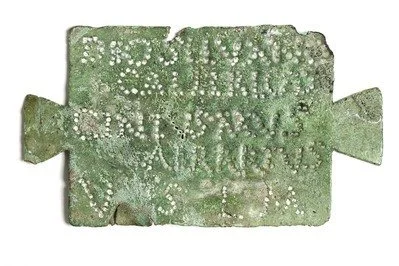
COLEM:1947.8
A rectangular sheet of copper alloy, turned green by time, with writing punched into it with small circular dots.
This is a votive plaque, given as an offering after a prayer was fulfilled.
It reads:
DEO SILVANO / CALLIRIO D(ATO) / CINTVSMVS AERARIVS / V(OTVM) S(OLVIT) L(IBENS) M(ERITO)
which translates to:
Given to the God Silvanus Callirius / Cintusmus the coppersmith / duly and gladly fulfilled his vow.
The syncretic god in question here is Silvanus Callirius, Silvanus being a known woodland god in the Roman world and Callirius likely being the local equivalent. The offering was made by a man named Cintusmus who was a coppersmith, leaving us to wonder why he was fulfilling a vow to the good of the trees. It is possible that he had asked for a shipment of wood, a vital part of any fire used in coppersmithing, and had prayed for its speedy arrival. Alternatively, he may have journeyed through woodland and had begged the god for safe passage. Sadly, we’ll never know the truth behind why this plaque was produced, but it provides us a glimpse into a single moment of the life a Colchester resident almost 2000 years ago.