Pompeii: Out of Time - Review
There have been many attempts over the years to get celebrities to try and engage the general public in the Ancient World. Rarely, if ever, does that celebrity have any sort of prior experience or knowledge of the topic in question other than being a general “history enthusiast”. That is not the case with the recent three-part series covering the destruction of Pompeii and Herculaneum presented by Tom Hiddleston.
With a Classics degree from Cambridge (and a very good one at that), he at the very least started the series with a strong understanding of the Ancient Roman World, its people and the events that happened in 79 CE. What’s more is that he went to the same college at Cambridge that I did, Pembroke, so I have even more time for him and this documentary.
The documentary takes the viewer hour by hour through the events leading to the eruption of mount Vesuvius and into the aftermath, something rarely done in the many other documentaries that have covered this subject before. He brings together specialists from a wide range of disciplines, geologists, psychologists, archaeologists and linguists, all giving different perspectives on the events that happened.
I was fortunate enough to visit both Pompeii and Herculaneum in October 2023. The scale of the place and the many named individuals you find as you explore both sites (I only managed a quarter of Pompeii in one day) give a wealth of stories to choose from. A three part documentary attempting to sum up the events through the eyes of just three individuals is incredibly ambitious, but it seems to have worked…
The series focuses on the lives of three real people, not made up, to give the viewer an idea of what might have happened throughout the 24 hours of chaos that surrounded the eruption of Vesuvius. Real people with historical and/or archaeological evidence for their existence. Their stories reflect the diverse experiences and reactions the people around the bay of Naples would have witnessed at that time.
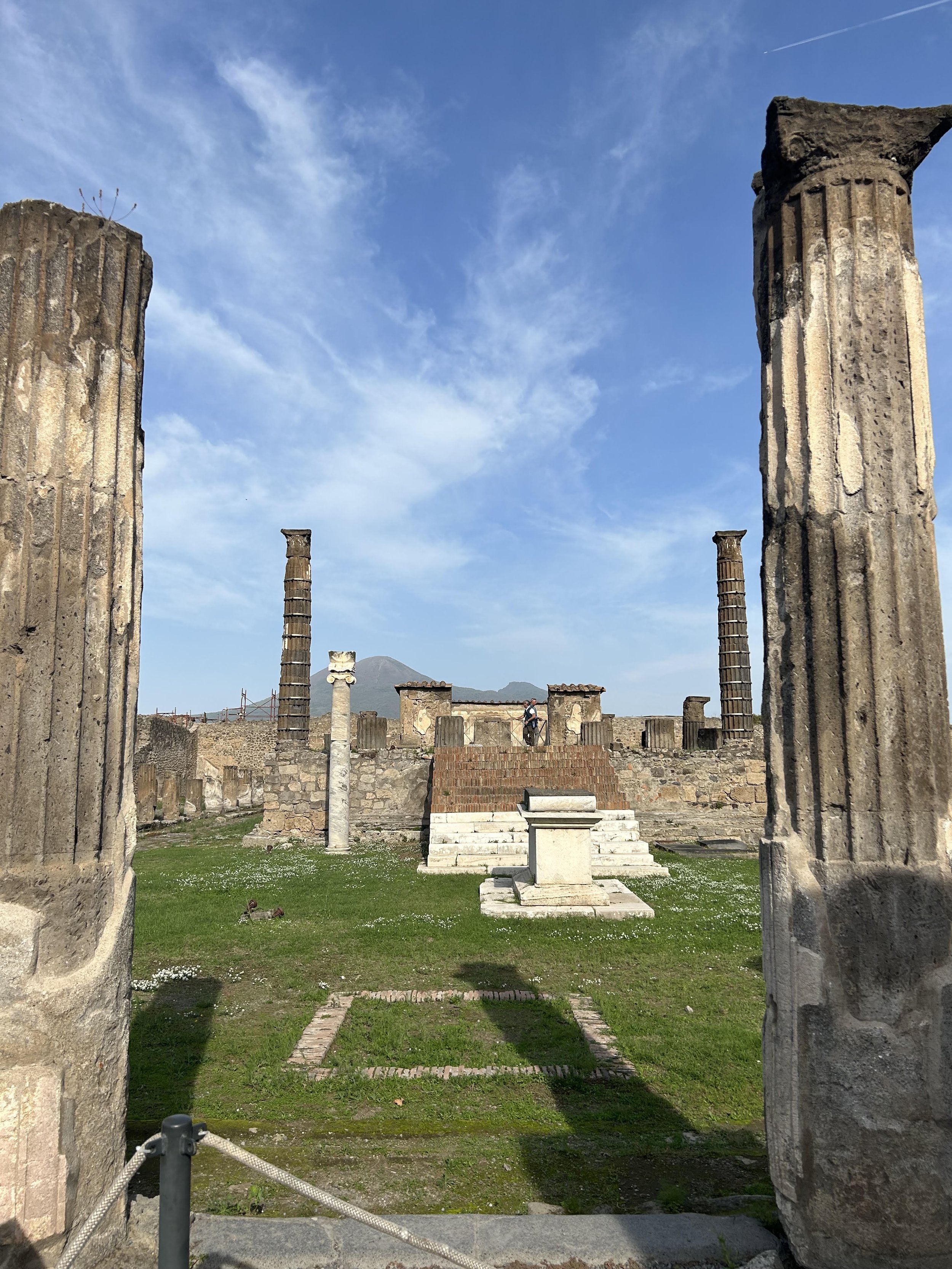
A view of Vesuvius from the Temple of Apollo in Pompeii. Photo taken by me in 2023.
The Praetorian
He is the only nameless character, but this is often the nature of archaeology. We might find the remains, but not the name. He highlights the story of Herculaneum, the first town to be hit by a pyrochlastic surge that came from Vesuvius.
There is some imagination needed to follow his story, a senior military official who happened to be on holiday in Herculaneum when the event happened. Another point often missed when this story is told through visual media, the town was a major vacation destination so there would have been plenty of people in the town who didn’t usually live there. Incredibly unfortunate timing for those that lost their lives.
Tom tells a tale of a man weary of war, seeing the rich live lavish lives off the spoil of his trauma. Although this is undoubtedly something some would have felt, there is definite creativity in this man’s story.
His remains were found alongside his belt and sword, as well as a pocket full of coins. The coins are interpreted as holiday spending money, as it’s a month’s salary, but we have so little in the way of “Roman pocket change” to know how much money Romans actually carried around with them. I think of the coins found in the Fenwick Hoard, which were in a box rather than a purse. It’s also important to remember that, in crisis, people grab their valuables and run so he may have taken all his savings before heading to the beach to flee.
Sadly, we know he didn’t make it and the story ends with him coordinating the escape efforts at the Herculaneum beach. Something we can certainly imagine with the way Tom so brilliantly brings this person to life through his narrative.
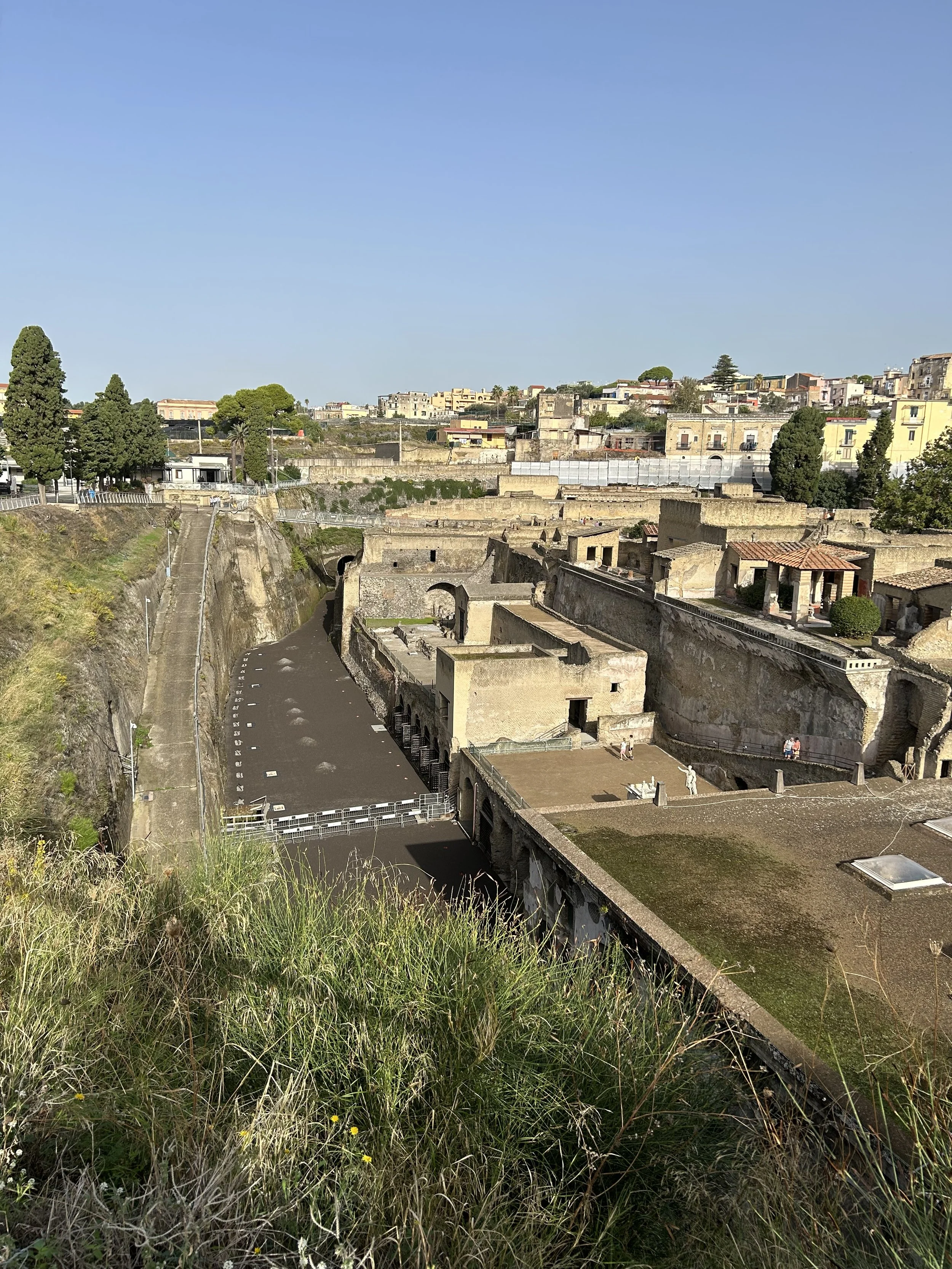
Looking down on the boat stores at the (former) beach at Herculaneum. Photo taken by me in 2023.
Julia Felix
Breaking the gender norms (that many of us broke years ago) we see a wealthy woman who lived in a large property in Pompeii. Although, the general public likely still imagine the Roman world run by men where women had no power. The truth is of course the Roman world was run by men where some women had some power.
Her house seems to have been emptied at the time of the eruption so she likely had the sense to clear the house when the eruption started. Although, as we find out, the remains of a wealthy woman were found near the shrine of Isis on the property. Although we cannot be certain this was Julia, considering many other wealthy people are depicted at her home at the time of the eruption, it shows us that even the wealthy could not escape.
Unlike the usual narrative of the rich protecting themselves at expense of all those around them, this series pitches Julia as a caring and compassionate women who tries to save those at her property. This bring up the ever present concept of Roman religion, showing that many would have indeed gone to the gods for help before trying to save themselves. Again with the Boudican event we see the people fleeing to the temple of Claudius at the time of the attack.
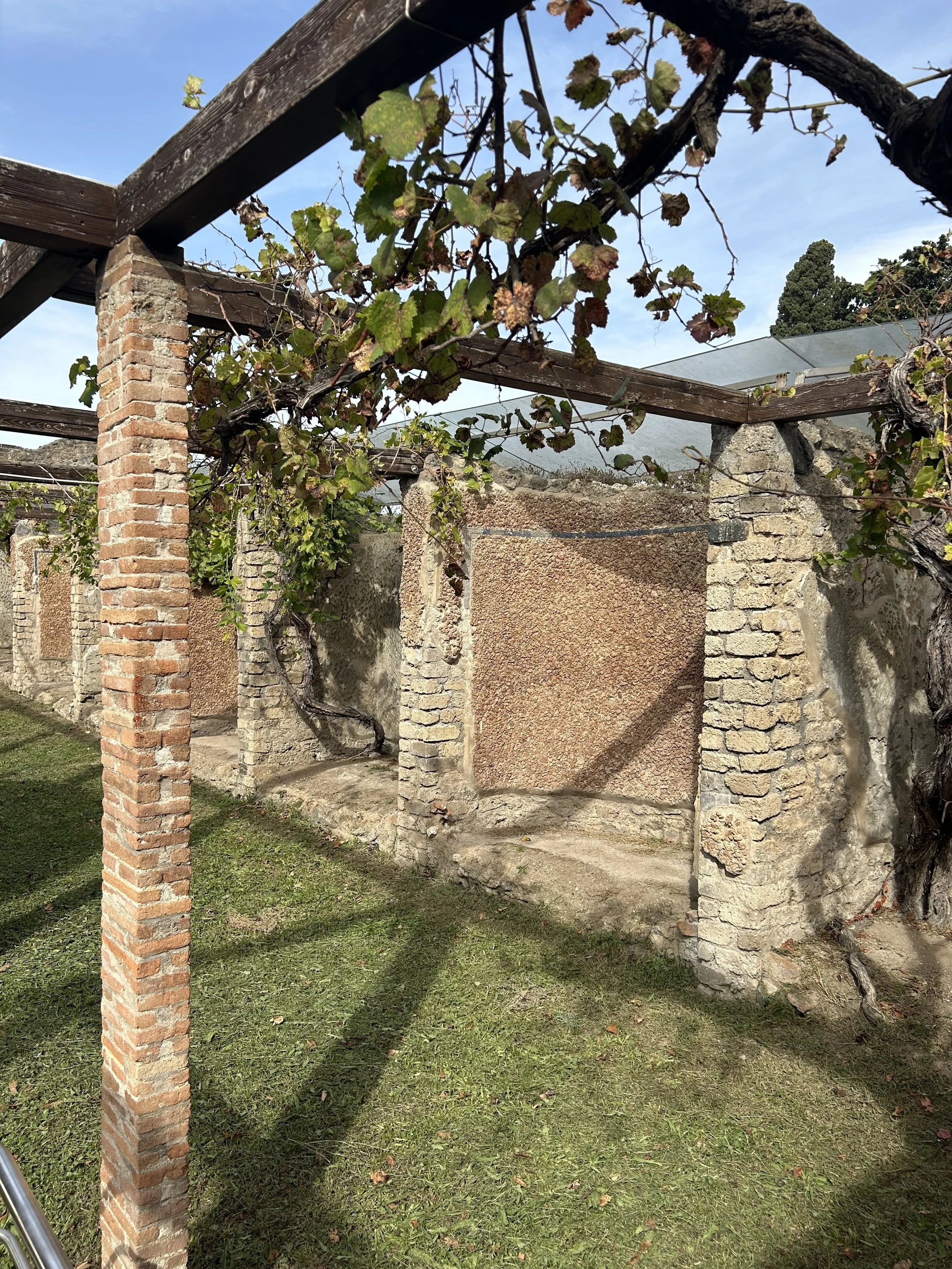
In the gardens of Julia Felix. Photo taken by me in 2023.
Avianius Felicio
Perhaps the most interesting character of the entire series and one that Tom helps develop spectacularly through the narrative is a child called Avianius. Sadly, it seems he escaped the eruption while his mother did not. Using the fancy brand new tech that was introduced at the top of the series (an excel spreadsheet), we follow the boys journey from the blacksmith’s he was an apprentice at, as he heads home to find his mum, before attempting to flee.
The public monument of his, wealthier and successful, grandfather and his own tombstone give us the two reference point to show his family’s fall from grace before the eruption to the boy having survived the catastrophe. Though he seems to have still died as a boy, he was at least fostered (maybe) after his escape, showing he had someone to care for him at least when the rest of his family were all gone. There is however no indication as to how he died, but it seems even more bitter sweet given he seems to have survived one of the greatest natural disasters in human history to die not long after.
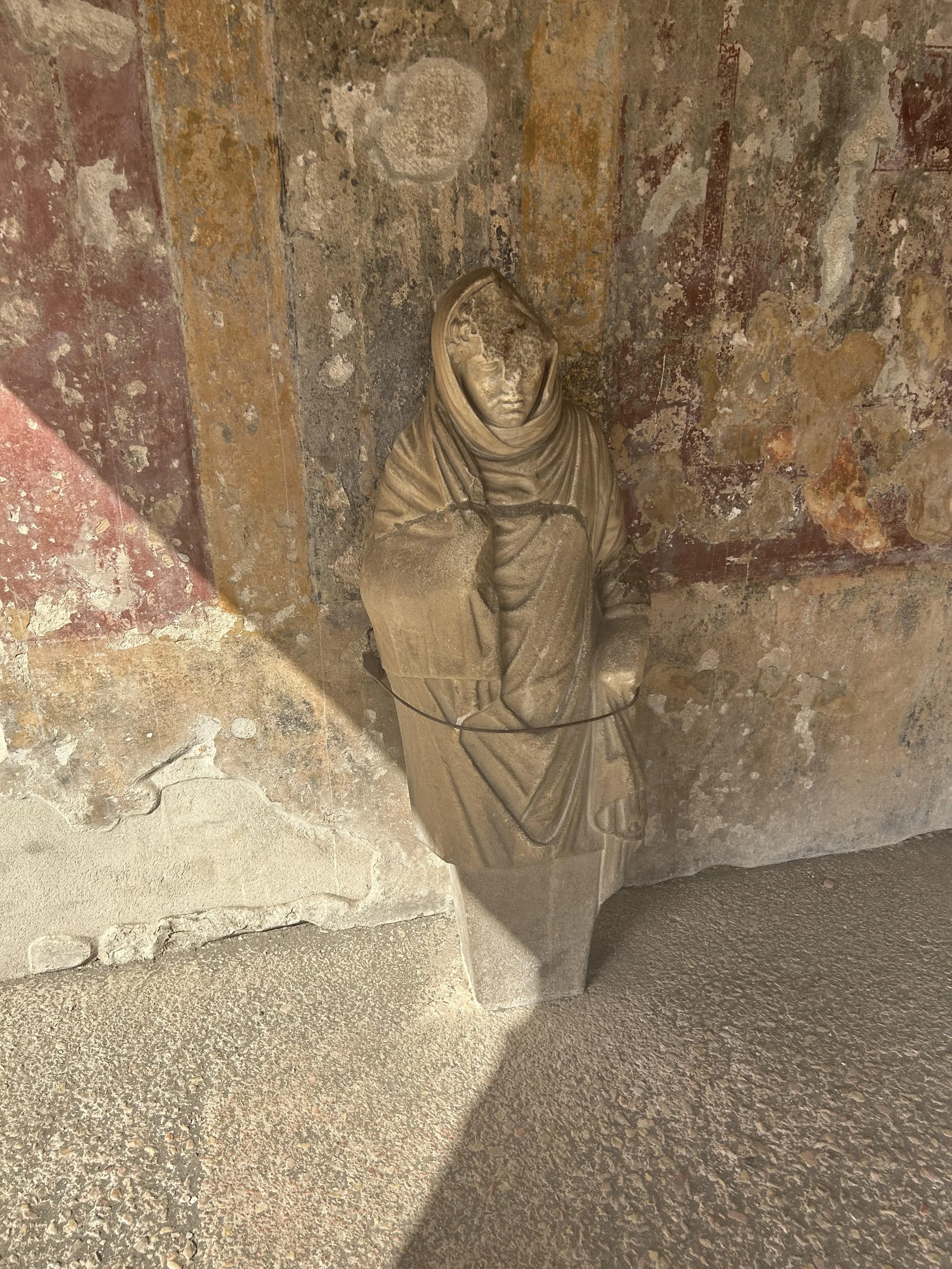
A sculpture of a Roman woman, wearing a matronly outfit much like what Avianius’ mother would have worn. Photo taken by me in 2023.
Conclusion
I can honestly say I have rarely seen a documentary that has done such a good job at explaining the complex events of the eruption of Vesuvius to an amateur audience, whilst still clearly showing all the actual forms of evidence that specialists use to understand the past. Tom’s attempts at translating the Latin himself, though possibly staged at times, also helps with the sincerity of Tom’s desire to find out the truth of what happened. I remember translating Pliny the Younger’s account of the eruption when I did my GCSEs, it having made a real impact on my desire to want to study the past through both written sources and the archaeology left behind. this series blends all forms of evidence fantastically and I feel many viewers will see themselves in Tom as he tries to piece together the pieces of the puzzle.
His honesty about archaeologists’ attempts to understand the past often failing due to lack of evidence is refreshing, rather than presenting all the stories as historic fact. Although, as mentioned above, some of the interpretations could be seen as a bit of a stretch, they’re all strongly grounded in evidence that is shared and explained to the viewer.
This combined with the dramatisations, reflecting the diversity of ancient Pompeii and Herculaneum, really brought life to these stories. what’s more, a great deal of thought went into the costume and sets with not only some spectacular colourful designs, but I did no spot a single anachronistic (at least all being broadly Roman) object. Although I’m sure I did spot a few white stone, unpainted sculptures….but it’s Tom Hiddleston so I’ll let him off.
In summary, this is a rare example of a documentary that I genuinely think would appeal to amateurs and specialists alike. A fantastic blend of approaches, brilliantly spread over three manageable episodes. I hope they do more documentaries in this style in the future. National Geographic…call me!
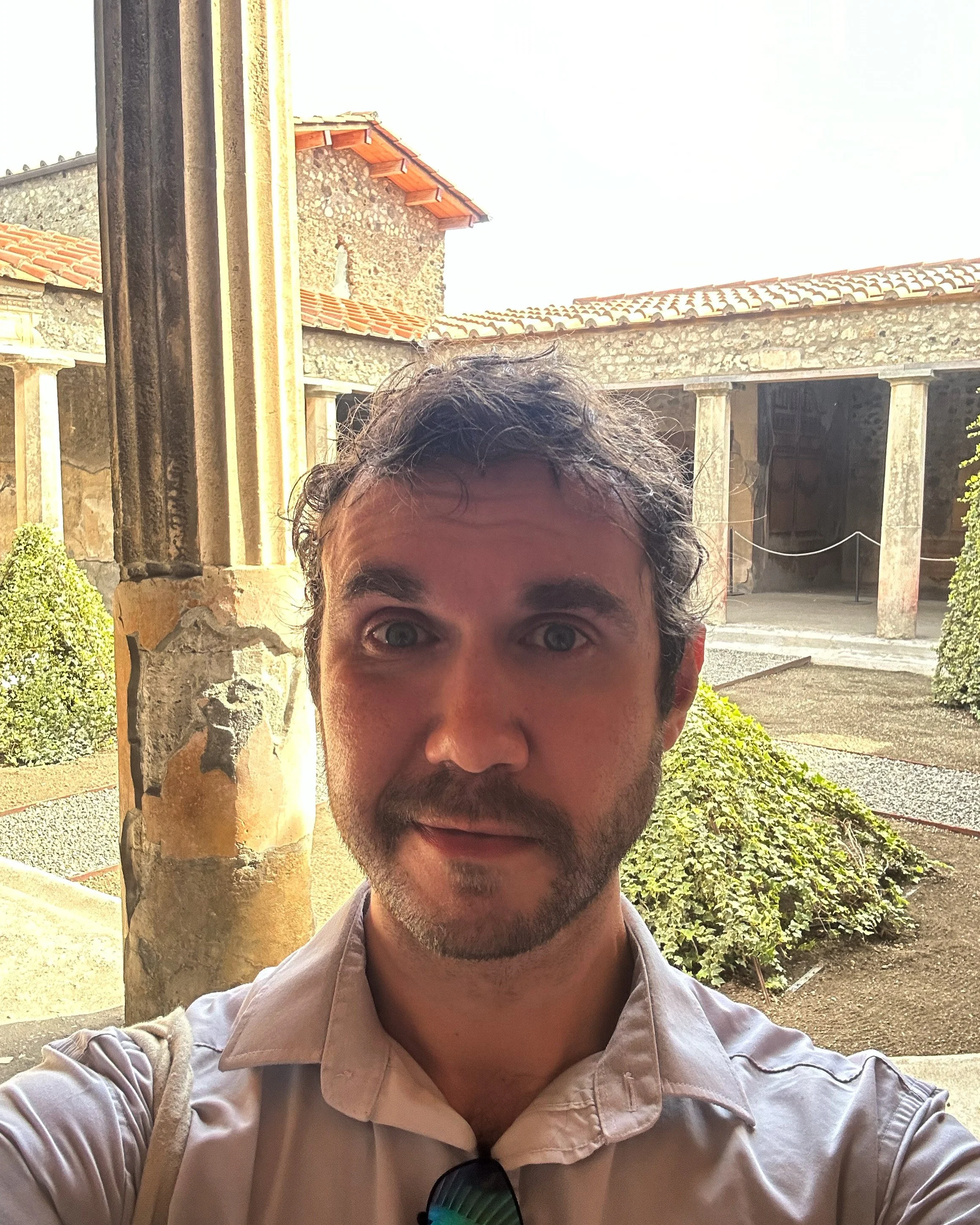
Me at the House of the Silver Wedding in 2023.